
Ferrous Sulphate in India: Heptahydrate & Monohydrate Uses for Crops, Animal Feed and Industry

By The Leela Partner Limited (formerly known as The Leela Corporation) | Last updated: September 2026 | Reading time: about 9-10 minutes

A farmer sees pale, yellow new leaves with green veins, and no amount of urea helps. A few sheds away, a young piglet is slow, pale, and not putting on weight. Two different problems, one hidden cause: iron that the plant or the animal cannot get.
The answer to both is a pale green crystal Indian agriculture has trusted for decades: ferrous sulphate (FeSO₄), also called green vitriol or copperas. It is cheap, dissolves easily and delivers iron in the form living things can use.
In this guide you will learn how it fixes crop chlorosis, where it fits in animal feed, which form (heptahydrate or monohydrate) and which grade to buy, and what else it does across industry.
Key Takeaways • Iron deficiency shows first on young leaves: yellow tissue with green veins. It is common in alkaline, calcareous soils. • Foliar spray works fastest; soil application with manure lasts longer. • Ferrous sulphate comes in two forms: heptahydrate (about 19-20% iron) and monohydrate (about 30-33% iron). Compare offers on cost per kg of iron, not per kg of product. • Grades differ: agriculture, feed, pharma, industrial, and electronic. Never use agriculture or industrial grade in feed, food, or medicine. • In animal feed, it is a low-cost iron source for premixes and mineral mixes, vital for young stock. • Always ask for COA, MSDS, and impurity limits, especially heavy metals, for feed grade. |
What Is Ferrous Sulphate?
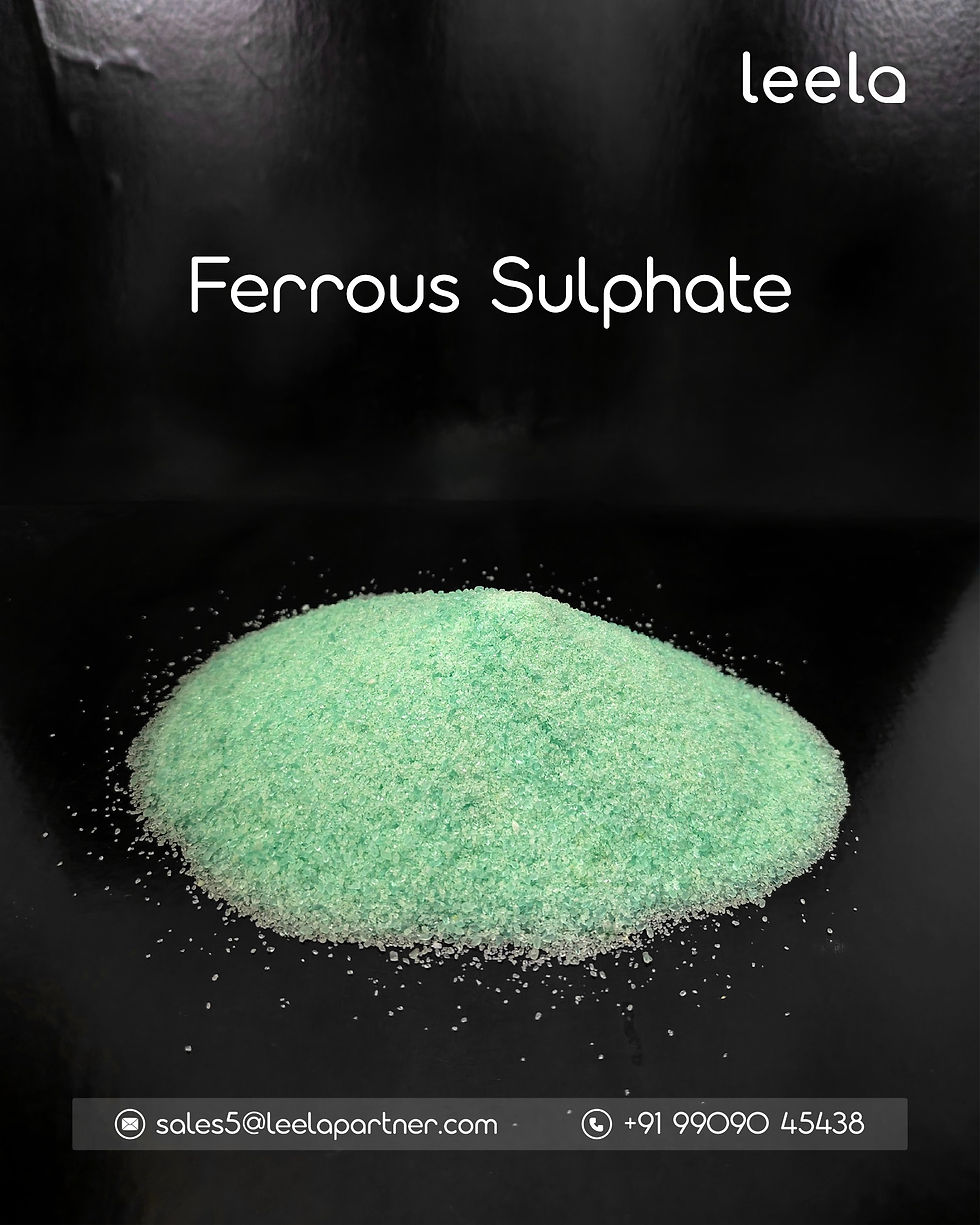
Ferrous sulphate is an inorganic salt of iron in its +2 (ferrous) state and sulphate. It is also written as iron(II) sulphate, iron sulfate, green vitriol or copperas. The word 'ferrous' tells you the iron is Fe²⁺, the form that dissolves easily in water and that plants, animals and people can use.
It is made by reacting iron with sulphuric acid, and large volumes also come as a by-product of steel pickling and titanium dioxide production. Depending on how much water is locked in the crystal, it appears as blue-green crystals (heptahydrate) or a paler, drier powder (monohydrate).
Quick facts:
• Chemical formula: FeSO₄·7H₂O (heptahydrate) and FeSO₄·H₂O (monohydrate)
• CAS numbers: 7782-63-0 (heptahydrate), 17375-41-6 (monohydrate)
• Synonyms: iron(II) sulphate, green vitriol, copperas
• Solubility: soluble in water, giving a slightly acidic solution
• HSN code: 28332910
Heptahydrate vs Monohydrate: Which Should You Buy?
Both are ferrous sulphate, but they behave differently in the field, the feed mill, and the store room.
• Heptahydrate (FeSO₄·7H₂O): blue-green crystals, about 19-20% iron, dissolves quickly. Best for foliar sprays, soil use, and water treatment.
• Monohydrate (FeSO₄·H₂O): pale green to white-yellow powder, about 30-33% iron, dissolves more slowly. Best for feed premixes, dry blends and granulation, and cheaper to transport per kg of iron.
Rule of thumb: choose heptahydrate when fast dissolving matters, and monohydrate when iron concentration and dry handling matter.
Property | Heptahydrate (FeSO₄·7H₂O) | Monohydrate (FeSO₄·H₂O) |
Chemical formula | FeSO₄·7H₂O | FeSO₄·H₂O |
Common names | Green vitriol, copperas, iron(II) sulphate | Dried ferrous sulphate, iron(II) sulphate monohydrate |
CAS No. | 7782-63-0 | 17375-41-6 |
EINECS No. | 231-753-3 | Confirm from your MSDS |
HSN code | 28332910 | 28332910 |
Appearance | Light green/blue-green crystals or free-flowing light green powder | Pale green to white-yellow powder or granules |
Approx. iron (Fe) content | About 19-20% | About 30-33% |
Molecular weight | About 278 | About 169.9 (confirm from MSDS) |
Solubility in water | High; slightly acidic solution | Soluble; dissolves more slowly |
Best for | Foliar sprays, soil use, fertigation, water treatment, solution making | Feed premixes, dry blends, granulation, dry fertilizer mixes |
Freight efficiency | Lower (more water weight) | Higher (more iron per kg) |
Purity options offered | 85%, 90%, 98% (confirm on COA) | Confirm assay on COA |
Grades available | Agriculture / Feed / Pharma / Industrial / Electronic | Agriculture / Feed / Pharma / Industrial |
Packaging | 25 / 50 kg HDPE bags, fibre drums, jumbo bags, custom bulk | 25 / 50 kg HDPE bags, fibre drums, jumbo bags, custom bulk |
Shelf life | Up to about 2 years, sealed and dry | Up to about 2 years, sealed and dry |
Origin | Gujarat, India | Gujarat, India |
Grades of Ferrous Sulphate: Agriculture, Feed, Pharma, Industrial and Electronic
Grade decides purity, impurity limits, and where the product may be used.
• Agriculture grade: for crops, soil and fertilizer blends.
• Feed grade: for animal premixes and mineral mixes; tighter limits on heavy metals and other impurities.
• Pharma grade: for iron tablets, capsules and syrups; must meet pharmacopoeial standards (IP, BP or USP).
• Industrial grade: for water treatment, cement, pigments and general chemistry.
• Electronic grade: for ferrites and other high-purity uses.
Purity options available: 85%, 90% and 98% (confirm the exact assay on the COA for each batch). Rule: never use industrial or agricultural grade in food, feed, or medicine.
Grade | Preferred form | Main uses | Key checks before buying |
Agriculture grade | Heptahydrate (also monohydrate for dry blends) | Crop micronutrient, soil amendment, fertilizer blending, foliar and fertigation use | Fe assay, solubility, insoluble matter, free-flowing and non-lumpy; FCO compliance if sold as fertiliser |
Feed grade | Monohydrate (also heptahydrate) | Premixes, mineral mixes, fortified feed for pigs, poultry, cattle and other livestock | Heavy metals (lead, arsenic, cadmium, mercury), Fe assay, batch COA; formulate as per a nutritionist |
Pharma grade | Heptahydrate or monohydrate as per pharmacopoeia | Iron tablets, capsules, syrups for anaemia | IP / BP / USP compliance, iron assay, controlled manufacturing to prevent oxidation, full documentation |
Industrial grade | Heptahydrate (mostly) | Water and wastewater treatment (coagulant, flocculant, phosphate and COD removal, cyanide neutralizer), cement chromate reduction, pigments, dye mordant | Fe assay, free acid, insoluble matter; consistent supply in bulk |
Electronic grade | Heptahydrate (98% purity) | Ferrites and other high-purity applications | High purity, low impurities; confirm specification with buyer |
Agriculture: Curing 'Yellow Leaf' Disease in Crops
Iron chlorosis is widely reported on calcareous soils with a pH of 8.0 or above. Free lime and bicarbonate-rich borewell water lock iron into forms roots cannot absorb, and waterlogging, low organic matter, and heavy phosphorus use make it worse.
It is reported in parts of Gujarat, Rajasthan, Maharashtra, Karnataka and Tamil Nadu, and also on sandy, light soils.
The clue is where the yellowing appears. Iron barely moves inside the plant, so deficiency shows on the newest leaves: yellow between green veins, and bleached white in severe cases. Nitrogen deficiency does the opposite and yellows the older, lower leaves first.
Yellow leaves can also mean zinc or sulphur shortage, so confirm with a soil or leaf test from your nearest KVK before spending money.
Crop-wise use of ferrous sulphate
Crop | Soil application | Foliar spray | Notes |
Groundnut | As per local advice | Repeated dilute foliar sprays (about 0.5%), often with a little citric acid | Very sensitive to chlorosis on calcareous soils; sprays help recovery and pod yield |
Sugarcane | About 25 kg/ha (about 10 kg/acre); more with FYM in severe cases | 0.25-0.5% every 7-10 days | Common in alkaline patches |
Rice nursery/upland rice | Irrigation and organic manure | About 0.5% on bleached seedlings | Aerobic / direct-seeded rice is prone to deficiency |
Cotton | As per local advice | About 0.5% foliar | Improved bolls and seed cotton yield in Karnataka trials |
Pulses | About 25 kg/ha (about 10 kg/acre) basal | 0.5% at about 25 and 40 days after sowing |
|
Wheat/maize | About 25 kg/ha with FYM on light, high-pH soils | About 0.5% at tillering / early growth | Confirm with local KVK |
Fruit trees (mango, citrus, pomegranate, grapes) | Mix with compost in the basin, as advised locally | About 0.5% foliar | Repeat 2-3 times if new leaves stay pale |
Vegetables (tomato, chilli, brinjal, potato) | With compost as advised locally | About 0.5% foliar | Test a small patch first |
Lawns/gardens/roses | Label rate only | Label rate only | Keep off paving and stone (rust stains); also controls moss |
How to apply it
• Foliar spray (fastest): mix 5 g per litre of water (0.5%). For a 15-litre pump, that is about 75 g. Add about 1 g of citric acid per litre (about 15 g per pump) to keep the iron active.
• Spray method: prepare fresh, spray in the morning or evening (never in hot midday sun), wet both sides of the leaves, and repeat 2-3 times at 7-10 day intervals. Test a small patch first for leaf burn.
• Soil application (longer-lasting): about 25 kg per hectare (roughly 10 kg per acre), mixed with well-decomposed farmyard manure or compost at sowing or planting. Severe cases, especially in sugarcane, may need more.
• Drip / fertigation: use a fully dissolved, filtered, low-concentration solution, and do not mix in the same tank with phosphates, lime, or alkaline products.
Common mistakes to avoid
1. Spraying without a diagnosis (yellow leaves can also mean nitrogen, zinc, or sulphur shortage).
2. Using too strong a solution, which burns leaves.
3. Mixing with lime or alkaline products in the same tank.
4. Using old brown lumps that have oxidised.
5. Spraying in strong midday sun.
6. Ignoring the root cause, such as waterlogging or very high soil pH.
Benefits for Farmers and Agro Businesses
For farmers:
• Corrects iron chlorosis quickly, especially with foliar sprays.
• Supports chlorophyll formation, photosynthesis, and greener, healthier plants.
• Helps acidify alkaline soil around the root zone, improving nutrient availability.
• Very cost-effective compared with chelated iron products.
For dealers, distributors and fertilizer blenders:
• Steady-demand micronutrient with easy handling; demand peaks before kharif sowing, in nurseries and in orchards.
• Blends well with zinc sulphate, manganese sulphate and boron in micronutrient mixes.
• Available in 25 / 50 kg HDPE bags for retail repacking, and in bulk or private-label packing.
• If you sell as a fertiliser, confirm compliance with the Fertiliser Control Order (FCO).
Note: For severe chlorosis on very high-pH soil, chelated iron (EDTA, EDDHA) can work faster but costs much more. Ferrous sulphate remains the most economical option for most farmers.
Animal Feed: Iron From Day One
Iron is a core part of haemoglobin, which carries oxygen in the blood, and of enzymes involved in energy metabolism and immunity. Without enough of it, animals develop anaemia, grow slowly and fall sick more often. Young and fast-growing stock are the most exposed. Piglets, for example, are born with low iron reserves and need supplementation within days of birth.
Feed-grade ferrous sulphate is added to premixes, mineral mixes and fortified feed for pigs, poultry, cattle and other livestock. It is popular because:
• It is cost-effective compared with organic iron sources.
• It has good bioavailability when properly formulated.
• The crystalline, powder, or granular material blends easily into feed. Monohydrate is often preferred for dry premixes because it packs more iron per kg.
Two cautions matter. First, iron must be balanced: too little causes anaemia, but too much can harm animals, so follow your nutritionist's advice and applicable feed standards. Second, feed grade needs tighter impurity control than agricultural grade, especially for heavy metals, so always ask for a batch COA.
Beyond the Farm: Other Uses of Ferrous Sulphate
• Water and wastewater treatment: forms iron hydroxide flocs that trap suspended solids, binds phosphate to prevent algae overgrowth, helps remove colour, odour and COD, and neutralizes cyanide in effluent. Textile, paper, food-processing and municipal plants use it.
• Pharma: one of the most common iron sources in tablets, capsules and syrups for iron-deficiency anaemia, made to pharmacopoeial standards.
• Cement: reduces toxic hexavalent chromium to safer trivalent chromium.
• Pigments and chemicals: raw material for iron oxide pigments, a precursor for ferric sulphate, ferrites and catalysts.
• Textile dyeing: a mordant that helps fix dyes to fabric.
• Steel and metal treatment: used in some pickling and surface-treatment processes.
• Lawns and gardens: greens up pale lawns and controls moss. Keep it off tiles, paving, and stone, because it leaves rust stains.
B2B Buyer's Checklist: 8 Things to Verify Before You Order
1. Hydrate form: heptahydrate or monohydrate?
2. Iron (Fe) assay: ask for the guaranteed percentage, not 'approx.'
3. Grade: agriculture, feed, pharma, industrial, or electronic. Match it to your end use.
4. Impurity limits: heavy metals, insoluble matter, and free acid, critical for feed and pharma.
5. Physical form: crystals, powder or granules, based on your blending or dosing system.
6. Packaging: moisture-resistant 25/50 kg HDPE bags, fibre drums, jumbo bags or custom bulk.
7. Documents: COA, MSDS, packing list, commercial invoice, and the correct HSN code (28332910).
8. Supply reliability: consistent batch quality, shelf life (up to about 2 years when stored correctly), and dependable lead times.
Storage and Handling: Stop the Green Crystals Turning Brown
Ferrous sulphate's biggest weakness is oxidation. In air and moisture, Fe²⁺ slowly converts to Fe³⁺ and the product turns yellow-brown, losing effectiveness. To protect your investment:
• Store in sealed, moisture-proof packaging in a cool, dry, well-ventilated place.
• Keep away from heat, direct sunlight, alkalis and strong oxidising agents.
• Wear gloves, goggles and a dust mask, and avoid creating dust.
• Wash hands after handling and never eat or drink near the material.
• Keep out of reach of children and animals. In case of ingestion, do not induce vomiting; seek medical help immediately.
Always read the MSDS for full handling, storage, and disposal guidance.
Why Source Ferrous Sulphate From The Leela Partner Limited?
Gujarat is India's chemical manufacturing hub, with strong transport links to farming states and ports. The Leela Partner Limited (formerly known as The Leela Corporation) supplies ferrous sulphate heptahydrate and monohydrate in agriculture, feed, pharma, industrial, and electronic grades, in 85%, 90%, and 98% purity options. Shipments are supported with COA, MSDS, packing list and commercial invoice, and packaging is customised by grade, hydrate form and order volume for domestic and international delivery.
The Bottom Line
Whether the problem is a yellowing crop or an under-nourished young animal, the cause is often the same: iron that cannot be reached. Diagnose it correctly, use the right dose or formulation, choose the right form and grade, and buy documented material. A few kilograms of green crystals will pay back many times over.
सारांश (हिंदी में)
फेरस सल्फेट (हरा कसीस) फसलों में आयरन की कमी दूर करने का सस्ता और असरदार उपाय है। धान, गेहूं, मूंगफली, गन्ना, कपास, दलहन, सब्जियों और फलदार पौधों में नई पत्तियों का पीला पड़ना और नसों का हरा रहना (क्लोरोसिस) इसका मुख्य संकेत है। आमतौर पर 0.5% घोल (लगभग 5 ग्राम प्रति लीटर पानी) में थोड़ा सा सिट्रिक एसिड मिलाकर सुबह या शाम 2-3 बार, 7-10 दिन के अंतर पर छिड़काव किया जाता है। मिट्टी में लगभग 25 किलो प्रति हेक्टेयर (करीब 10 किलो प्रति एकड़) गोबर की खाद के साथ दें। पशु आहार में केवल फीड ग्रेड ही उपयोग करें। मात्रा हमेशा मिट्टी जांच और स्थानीय कृषि विशेषज्ञ (KVK) की सलाह से तय करें।
Frequently Asked Questions
What is ferrous sulphate used for?
It is used as an iron micronutrient in agriculture, an iron source in animal feed and supplements, a coagulant and phosphate remover in water treatment, and a reducing agent and raw material in industry.
What is the dose of ferrous sulphate per acre?
A commonly cited soil dose is about 25 kg per hectare (roughly 10 kg per acre), or a 0.5% foliar spray (5 g per litre). Confirm with a soil test and your local KVK.
What is the foliar spray ratio for ferrous sulphate?
Mix about 5 g per litre of water (0.5%), or about 75 g per 15-litre pump, with a little citric acid. Spray in the morning or evening, 2-3 times at 7-10 day intervals, and test a small patch first.
How long until crop leaves turn green?
New leaves often improve within one to two weeks of a foliar spray. Leaves that are already yellow may not fully recover.
Which is better, heptahydrate or monohydrate?
Heptahydrate (about 19-20% iron) suits farm use because it dissolves easily. Monohydrate (about 30-33% iron) suits feed and dry blending because it gives more iron per kilogram.
What grades of ferrous sulphate are available?
Agriculture, feed, pharma, industrial and electronic grades, in both heptahydrate and monohydrate forms. Pick the grade that matches your end use and check the COA.
Is ferrous sulphate used in animal feed?
Yes. Feed-grade ferrous sulphate is added to premixes and mineral mixes as an iron source, especially for young stock like piglets. Follow a nutritionist's formulation and use only feed-grade.
Can I use agriculture grade ferrous sulphate in animal feed?
No. Feed needs tighter impurity limits, especially for heavy metals. Use only certified feed-grade material with a batch COA.
Which crops need ferrous sulphate?
Groundnut, sugarcane, rice, cotton, pulses, wheat, maize, vegetables, and fruit trees such as citrus, mango, and pomegranate often respond, especially on alkaline, sandy, or calcareous soils.
Is ferrous sulphate soluble in water?
Yes. It dissolves readily to give a slightly acidic solution containing Fe²⁺ ions. It has very low solubility in alcohol.
Why does ferrous sulphate turn brown?
Air and moisture oxidise Fe²⁺ to Fe³⁺, giving a yellow-brown colour and reducing effectiveness. Sealed, moisture-proof packaging and cool, dry storage prevent this.
Can ferrous sulphate be mixed with other fertilizers or sprays?
It blends well with zinc, manganese and other sulphate micronutrients. Avoid mixing with lime, phosphates or alkaline products, and do a small jar test first.
What is the shelf life of ferrous sulphate?
Up to about two years when stored in sealed, moisture-resistant packaging in a cool, dry place.
Do you provide COA and MSDS, and supply in bulk?
Yes. The Leela Partner Limited supplies COA and MSDS with every shipment, in 25/50 kg bags and custom bulk packing, to dealers, feed mills, fertiliser manufacturers and industrial users.
Can gardeners use ferrous sulphate on lawns and plants?
Yes, many gardeners use it to treat iron chlorosis and control moss. Follow label rates, avoid overapplication, keep it off paving and stone to prevent staining, and store it away from children and pets.
Disclaimer: Doses are general guidelines from published Indian research and university recommendations. Soil, crop stage and water quality change the right dose, so confirm with a soil test and your local KVK or state agriculture university. Feed formulations should follow a qualified animal nutritionist and applicable standards. This article is not medical advice; if you are considering iron supplements, speak with a doctor or pharmacist first.
Comments